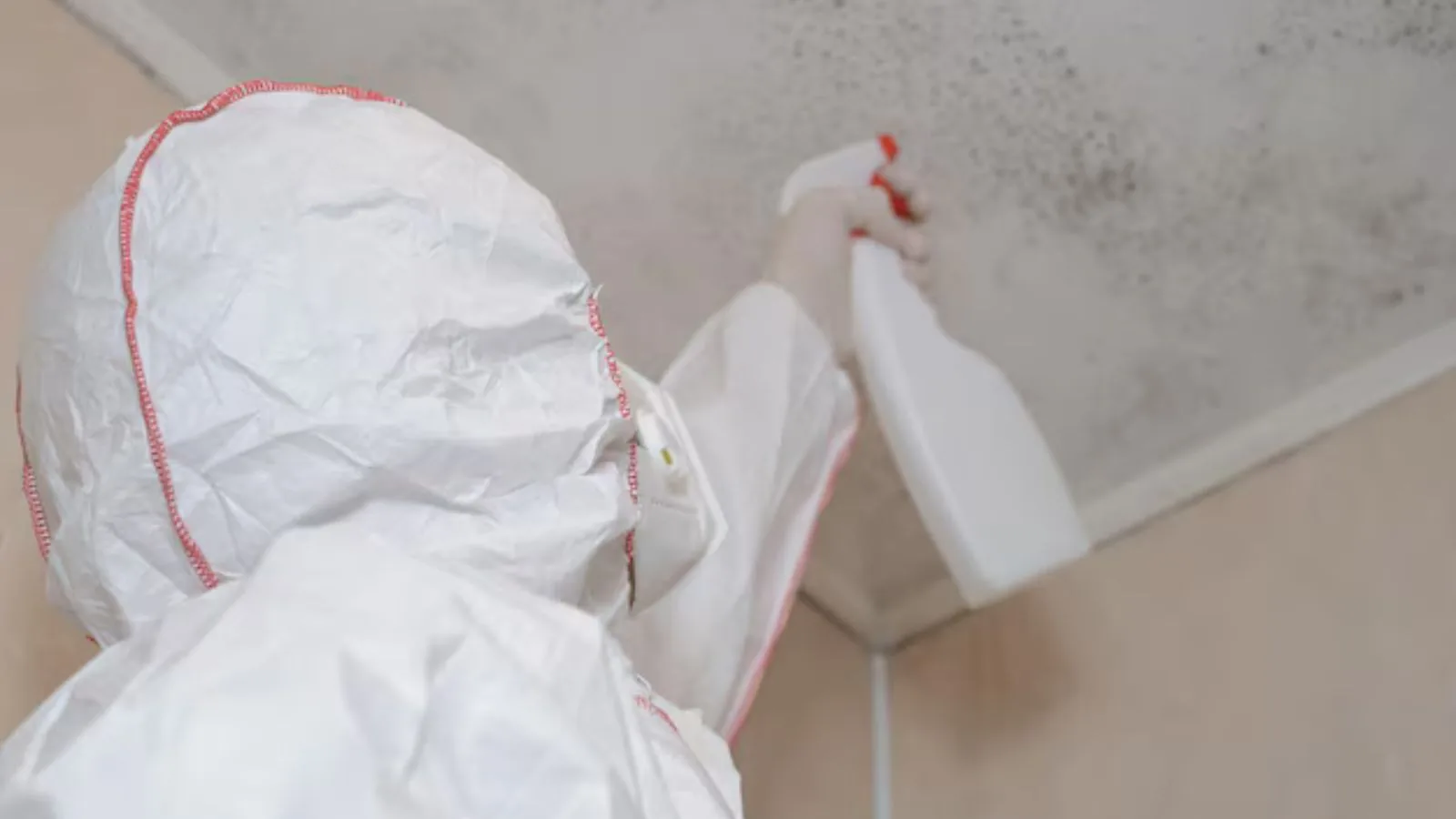
Mold remediation is the containment, removal and cleaning of mold growth, together with the correction of the moisture that allowed it. The published standard for the work is ANSI/IICRC S520, and homeowners can ask any company whether its crews work to it. Mold needs moisture to grow, so removing the water source and drying the structure are the first steps.
If you see growth, stay out of the area, keep the HVAC from running through it and avoid scrubbing or bleaching. Disturbing growth spreads spores, and cleaning without containment can make it worse.
Musty smell or dark spots after a leak?
That is how most homeowners describe a mold problem before anyone says the word. A musty odor in a closet, dark speckling on a ceiling or wall, or paint that peels over a damp patch all point to moisture. Mold often follows a leak that was not dried in time.
The work that follows is called mold remediation. It starts with finding the moisture, because removing mold without fixing the water only brings it back.
How mold remediation is done
- Find the moisture. Moisture meters and thermal imaging locate the wet material that feeds growth.
- Contain. Plastic barriers and negative air keep spores from spreading to clean rooms.
- Remove. Porous materials with growth are cut out, and other surfaces are cleaned with HEPA vacuums and wipes.
- Dry. Air movers and dehumidifiers dry the area so growth does not restart.
- Verify. A visual check and moisture readings confirm the area is clean and dry.
Industry reference
The ANSI/IICRC S520 standard for professional mold remediation guides containment, removal and cleaning, and the Connecticut Department of Public Health points owners to it. The state does not license mold contractors, so ask which standard a company follows.
Safety steps before work starts
- Do not disturb visible mold with a broom or dry brush.
- Turn off fans that blow across moldy areas.
- Keep children, pets and people with asthma away from the area.
- Wear gloves, eye protection and a well-fitted mask for small tasks.
- Fix the moisture source before cleanup.
Think you have mold?
Call for an assessment of the moisture and a plan. We explain scope and price before work starts.
What the State of Connecticut says
The Connecticut Department of Public Health notes that the state does not license or certify mold assessors or abatement contractors, recommends the S520 standard and says air sampling is usually not needed. The Department of Consumer Protection separately lists a mold remediation designation under the home improvement contractor registration for residential work, and asks for NORMI or IICRC certification for it.
Because the two agencies describe the field differently, ask any company what applies and how its crews follow S520. You can also check a contractor's registration on the state eLicense lookup. We make no health claims, and health questions belong to a physician.
Testing, no testing and visual assessment
| Approach | When it is used | Note |
|---|---|---|
| Visual and moisture assessment | Most residential jobs | Looks for growth and wet material |
| Surface or bulk sampling | Unclear materials or disputes | A lab result still needs interpretation |
| Air sampling | Rarely needed | The state health department says it is usually not needed |
| Clearance check | After remediation | Visual and moisture confirmation |
Where mold shows up after water damage
The most common places are the back of drywall, under carpet and pad, in crawl spaces and attics, and around leaking fixtures. Humid Connecticut summers raise indoor humidity, so a damp basement can stay damp for weeks. See crawl space water damage and carpet water damage for two common sources.
We serve mold calls in the Greenwich ZIP codes 06830, 06831 and 06836 and the village ZIP codes 06807 for Cos Cob, 06870 for Old Greenwich and 06878 for Riverside. Mold costs less when it is caught early, and drying quickly is the best defense.
What affects the cost
- Area of growth. A small patch versus several rooms.
- Materials involved. Removal of drywall, insulation and flooring adds work.
- Containment. Barriers and air filtration add steps.
- Moisture source. Fixing the leak is a separate trade.
- Rebuild scope. Repairs follow the remediation.
General note on insurance: mold coverage varies and often depends on the cause. Ask your insurer what applies and keep photos of the growth and the water source. Want your real number? Call (914) 732-9604.
Questions about mold remediation
Look for moisture first. A moisture reading in nearby walls and floors can find a hidden source, and visible growth is not always present.
The Connecticut Department of Public Health says air sampling is usually not needed. A visual and moisture assessment comes first.
We make no promise. Mold needs moisture, so if the source is fixed and the area stays dry, the risk drops.
Bleach does not address the moisture and does not penetrate porous materials. Remediation follows S520 instead.